Last updated: 31 August 2026
Where exactly is the affected area
The affected corridor
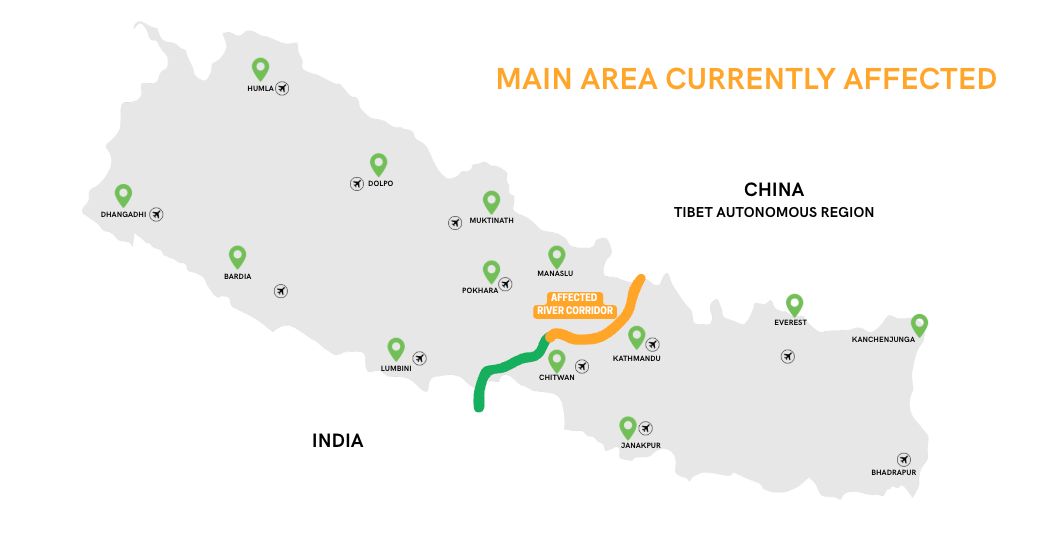
Orange marks the corridor currently affected by the flood — the Bhote Koshi through the Trishuli toward Chitwan and Nawalparasi. Reference points shown for orientation only; always confirm current road and route status with your operator before travelling.
Nepal Travel FAQ
Current information for travellers following the Rasuwa–Bhotekoshi flood. Sourced from NDRRMA and Nepal Police official bulletins — the situation is changing multiple times a day, so always check the live tracker link below for the latest figures.
Got something unanswered? Talk to Us!
We’re here to help — reach out anytime.
No. The flooding is concentrated along the Bhote Koshi–Trishuli river corridor.
What this means for you: Most tourism destinations elsewhere in Nepal continue to operate, subject to normal monsoon conditions.
Source: NepalNow — verified 31 Aug 2026
The affected area is the Bhote Koshi River from Rasuwagadhi and Timure at the Tibet border, down through the Trishuli corridor into Nuwakot, Dhading, Gorkha and Nawalparasi. See the map above.
Affected — avoid travel
What this means for you: Trekking routes that use this corridor — Langtang, the Tamang Heritage Trail, Gosaikunda and the Rasuwagadhi border crossing — should currently be avoided.
Source: NDRRMA / Copernicus Emergency Mapping Service (EMSR927) — verified 31 Aug 2026
There’s no single answer for the whole country. Conditions depend heavily on your destination and route.
What this means for you: Check current conditions for your specific destination before travelling, rather than relying on general headlines about Nepal.
Source: NepalNow — verified 31 Aug 2026
The Bhote Koshi–Trishuli corridor, including Langtang, Tamang Heritage Trail, Gosaikunda and Rasuwagadhi, plus riverside areas of Nuwakot, Dhading, Gorkha and Nawalparasi.
Affected — avoid travel
What this means for you: These areas remain active search-and-rescue zones — avoid non-essential travel there.
Source: NDRRMA — verified 31 Aug 2026
No — these areas fall directly within the affected corridor. Rasuwagadhi is also the main overland gateway to Tibet for the Kailash Mansarovar pilgrimage, and hundreds of pilgrims are among those still unaccounted for.
Affected — avoid travel
What this means for you: Postpone travel on these routes. Rescue resources are concentrated here, and non-essential travel adds pressure on the response.
Source: NDRRMA / Nepal Police — verified 31 Aug 2026
Kathmandu continues to operate as Nepal’s main international gateway and is not directly in the flood’s path, though it is the hub for relief and rescue operations.
Operating
What this means for you: Check current flight and local transport information before travelling, as relief traffic and monsoon weather can both affect schedules.
Source: NepalNow — verified 31 Aug 2026
Pokhara is outside the affected corridor and remains accessible, including by air from Kathmandu.
Operating
What this means for you: We recommend flying rather than the overland route via Mugling/Prithvi Highway, which passes close to the affected corridor and currently has diversions in place.
Source: NDRRMA road status — verified 31 Aug 2026
The Annapurna region is outside the Bhote Koshi–Trishuli corridor.
Operating
What this means for you: Conditions can still change during monsoon, so check your specific route with your operator before travelling.
Source: NepalNow — verified 31 Aug 2026
The Everest region is outside the affected corridor.
Operating
What this means for you: Check current flight conditions to Lukla and route conditions with your operator, particularly during monsoon.
Source: NepalNow — verified 31 Aug 2026
Chitwan is outside the affected corridor and continues to operate normally, though the Trishuli river corridor passes nearby.
Operating
What this means for you: Conditions can still change during monsoon, so confirm with your operator or hotel before travelling.
Source: NepalNow — verified 31 Aug 2026
International flights into Kathmandu are operating.
Operating
What this means for you: Check your specific flight directly with your airline, as schedules can be affected by both monsoon weather and relief-flight priority.
Source: Airline sources — verified 31 Aug 2026
Most domestic flights, including to Pokhara, continue to operate, though helicopter capacity in the affected region is currently prioritised for search and rescue.
Operating
What this means for you: Confirm your specific route and flight with your airline or tour operator before travelling, especially if it involves helicopter transport.
Source: Domestic airline sources — verified 31 Aug 2026
Roads within the affected corridor have been severely disrupted — the road linking Betrawati (Nuwakot) to the Rasuwagadhi border has reportedly been swept away, and the Bidur–Dhunche road in Rasuwa is restricted to small 4-wheel vehicles only. Alternative routes around the Prithvi Highway (Kathmandu–Pokhara via Mugling) are open with alerts in place.
Affected — avoid travel
What this means for you: Avoid the overland route toward the affected corridor entirely. For other routes, check current conditions with your operator, as landslides are also possible during monsoon regardless of this disaster.
Source: NDRRMA / Department of Roads — verified 31 Aug 2026
This area is an active disaster response and search-and-rescue zone.
Affected — avoid travel
What this means for you: Contact your travel company immediately. If you booked through an international operator, ask them to consult their Nepal-based partner, who is best placed to assess current access and adjust your route.
Source: NepalNow — verified 31 Aug 2026
Not simply because of this disaster, if your itinerary does not pass through the affected corridor.
What this means for you: Check your itinerary with your travel company and its Nepal-based partner. Routes can often be adjusted rather than cancelled outright.
Source: NepalNow — verified 31 Aug 2026
If you are outside the affected corridor, most services continue to operate normally.
What this means for you: Stay in contact with your operator or hotel, monitor official updates, and avoid non-essential travel into the Trishuli riverside districts (Nuwakot, Dhading, Gorkha, Chitwan), which have been placed on high alert.
Source: Nepal Police — verified 31 Aug 2026
Weather and flood warnings are issued by Nepal’s disaster and meteorological authorities and updated regularly.
What this means for you: Check the Department of Hydrology and Meteorology and NDRRMA directly before travelling near any river corridor during monsoon.
Source: Department of Hydrology and Meteorology / NDRRMA — verified 31 Aug 2026
National emergency numbers currently in effect: Rescue 1234, Police 100, Ambulance 102, National Emergency Operation Centre (NEOC) 1144. Tourist Police Head Office is in Bhrikutimandap, Kathmandu (inside the premises of Nepal Tourism Board), Tel: +977-01-4247041, +977-9851289444.
What this means for you: Save these numbers before you travel, particularly if heading outside Kathmandu.
Source: Nepal Police / NEOC — verified 31 Aug 2026
NDRRMA and Nepal Police are the official channels for missing-person information. A community-run tracker (nirajbhusal.github.io/rasuwa-flood-bulletin) also aggregates official bulletins and offers a name-search tool, which can be a useful supplement.
What this means for you: Use official channels first; treat volunteer trackers as a helpful cross-reference, not a substitute.
Source: NDRRMA / Nepal Police — verified 31 Aug 2026
Official channels include the Nepal Red Cross Society and the Prime Minister’s Disaster Relief Fund.
What this means for you: Give through verified official channels only, and be cautious of unofficial appeals circulating on social media.
Source: Nepal Red Cross Society / PM Disaster Relief Fund — verified 31 Aug 2026
NDRRMA and Nepal Police issue the official bulletins. Because figures are changing multiple times a day, a community-run tracker (nirajbhusal.github.io/rasuwa-flood-bulletin) aggregates these bulletins with citations and can be useful for frequent checking.
What this means for you: Don’t rely on a single headline number — check the timestamp on any figure, and prefer official NDRRMA bulletins when making travel decisions.
Source: NDRRMA; community tracker linked above — verified 31 Aug 2026
Yes. Road access into the flood-affected areas of Rasuwa is severely disrupted at present. There are also temporary disruptions on sections of the main highway between Kathmandu and Pokhara — work is underway to restore access, but travellers should expect possible delays and changing road conditions.
Affected — avoid travel
What this means for you: Where the main highway is disrupted, alternative road routes via Hetauda may be available, though these can add considerable travel time. Flying between Kathmandu and Pokhara is also an option, subject to weather and flight operations. Check the latest information with your tour operator, transport provider or relevant authorities before travelling.
Source: NDRRMA / Department of Roads — verified 31 Aug 2026
Got something unanswered? Talk to Us!
We’re here to help — reach out anytime.
Share Your Story with #NepalNOW
Have a story, photo, or video from your travels or community? Submit it and inspire others.


